The Agentic Era Arrived Early. Don’t Get Caught Off Guard by Late AI Governance.


While these seismic shifts in software development and security seem to be regular occurrences in 2026, the arrival of Anthropic's latest, reportedly "most dangerous" AI coding model yet, Claude Mythos, represents a permanent, fundamental shift in how every security leader must approach their security program, especially with patch management of legacy systems.
Most enterprises are still navigating the shift from human-written code to AI-assisted development, ushering in new processes, learning to review what their AI co-pilots generate, building new skills, and establishing new guardrails around appropriate enterprise use.
But, the next phase of AI-driven software creation didn't wait.
This week, Anthropic published a detailed technical assessment of Claude Mythos Preview, a new frontier AI model with a capability that should stop every security and engineering leader in their tracks. It can autonomously identify and exploit zero-day vulnerabilities across all major operating systems and browsers, without human intervention after an initial prompt. Engineers with no formal security training directed the model overnight and woke up to complete, working exploits.
These findings are startling and not theoretical. Mythos Preview found a 27-year-old vulnerability in OpenBSD, one of the most security-hardened operating systems in the world, that allowed an attacker to remotely crash any machine just by connecting to it. It discovered a 16-year-old flaw in FFmpeg that automated testing tools had hit five million times without catching. It chained together multiple Linux kernel vulnerabilities autonomously to achieve full machine control. These weren't human-assisted discoveries; no real-world practitioner guided the process after the initial prompt.
In response, Anthropic announced Project Glasswing, a cross-industry coalition that brings together AWS, Microsoft, Google, Cisco, CrowdStrike, Palo Alto Networks, JPMorgan Chase, NVIDIA, Apple, Broadcom, and the Linux Foundation. The shared conclusion across all of them: the old approaches to securing software are no longer sufficient, and the time to act is now. As CrowdStrike's CTO put it, the window between a vulnerability being discovered and exploited has collapsed; what once took months now happens in minutes.
The three problems just got harder
At every stage of the AI development transition, enterprises face the same three challenges. Mythos Preview sharpens all three at once, at a speed never previously possible.
Learning to build securely gets harder when AI can generate and modify code faster than teams can review it. The skills required to govern AI-generated code differ from those needed to write code manually, and those skills must keep pace with the tooling.
Governing what AI can and can't touch becomes critical when autonomous agents write and revise code without a human in the loop. Generally, we are still asking the wrong question. It’s less "what did our developers build?" and more "what did our AI build, and was it allowed to?"
Tracing which AI did what, where, and for whom is now a compliance and incident response imperative. When something goes wrong in an agentic pipeline, organizations need to answer that question immediately. Most can't.
As practitioners, we predicted long ago that this technology could eventually be leveraged by threat actors, effectively supercharging their attack capabilities. We already know that cybercriminals have a distinct offensive advantage over most enterprise security teams, and a tool like Mythos streamlines their nefarious processes even further.
We're in the age of democratized cyberattacks, where the level of destruction once achievable only by elite threat actors can be carried out by a relative novice. We shouldn't be shocked, but many remain vastly underprepared. Swift, prioritized patching is a must, but this management is only ever as good as the traceability of every tool and dependency in use.
This is an industry-level problem
What makes Project Glasswing significant isn't solely determined by the capabilities Mythos Preview revealed; it is the scale and potency of the response. A coalition spanning hyperscalers, security vendors, financial institutions, and open-source foundations is all aligned on the same conclusion, and it’s a familiar narrative that speaks directly to the ethos of SCW. AI Software Governance has never been a “nice-to-have”, optional feature. This is the missing layer that every organization scaling AI-driven development needs in place before the next incident. Those who stick to an oft-used, reactive playbook are going to be swept off their feet in the worst possible way.
Enablement, not restriction
The temptation when reading findings like these is to reach for the brakes, to slow AI adoption, restrict tooling, and tighten controls. That's the wrong response, and it's not what the Glasswing partners are recommending either.
The organizations that will navigate this transition well are the ones that adopt AI-driven development with governance in place from the start. That means training developers as the tooling evolves, setting guardrails for what AI agents can access in your repositories, and, fundamentally, building the traceability that your compliance and incident response teams will demand without burning millions of tokens to facilitate it.
The moment to act is now
Anthropic's own advice to defenders: start with the tools available today. Don't wait for the next model. The value of getting your processes, scaffolds, and governance frameworks in place compounds quickly.
Secure Code Warrior sits at the center of all three enterprise problems the agentic era creates. If your organization is scaling AI-driven development, the question isn't whether you need AI Software Governance. It's whether you have it yet.
What this means for you
최고정보보안책임자(CISO)를 위한
Your vulnerability disclosure policies, patch cycles, and incident response playbooks were built for a world where exploit development took weeks. That world is gone. Now is the time to establish AI governance visibility across your development environment, while contextually understanding which AI agents are touching your codebase, what they're producing, and whether it meets your risk threshold. If you can't answer those questions today, that's the gap to close first.
For CTOs
Your engineering teams are already using AI to ship faster. The question is now whether you have the guardrails in place to do it safely at scale. Governing what AI agents can and can't touch in your repositories, and maintaining traceability of AI contributions, is now a technical architecture decision, rather than an isolated security consideration. The organizations building this foundation now will be the ones who scale AI development with confidence.
For Engineering Leaders
Your developers are being asked to move faster with AI tools they didn't design and can't fully predict. The skills required to review AI-generated code are genuinely different from those required to write code manually, and most teams haven't had the chance to develop them yet. Closing that capability gap is what makes AI adoption safer and more sustainable.
For CEOs and Boards
Project Glasswing might be headline news, but it’s also a signal we cannot ignore. When AWS, Microsoft, Google, Cisco, CrowdStrike, and JPMorganChase align on an urgent, coordinated response to an AI-driven security risk, and Anthropic commits $100M to address it, that's the market telling you something. AI-driven software development is accelerating the rate at which vulnerabilities can be found and exploited. Governance over that process is now a board-level risk question. The organizations that treat it as one early will be better positioned to scale AI development — and to demonstrate to regulators, customers, and investors that they're doing it responsibly.
.png)
Anthropic's Claude Mythos represents a permanent, fundamental shift in how every security leader must approach their security program, especially with patch management of legacy systems.
마티아스 마두 박사는 보안 전문가, 연구원, CTO, 그리고 Secure Code Warrior의 공동 창립자입니다. 마티아스는 겐트 대학교에서 정적 분석 솔루션을 중심으로 애플리케이션 보안 분야 박사 학위를 취득했습니다.이후 미국의 Fortify에 합류하여 개발자가 안전한 코드를 작성하도록 지원하지 않고 단순히 코드 문제를 탐지하는 것만으로는 불충분하다는 점을 깨달았습니다. 이를 계기로 개발자를 지원하고 보안 부담을 줄이며 고객 기대를 뛰어넘는 제품을 개발하게 되었습니다. Team Awesome의 일원으로 책상에 있지 않을 때는 RSA 컨퍼런스, BlackHat, DefCon 등의 컨퍼런스에서 발표하는 무대 발표를 즐깁니다.
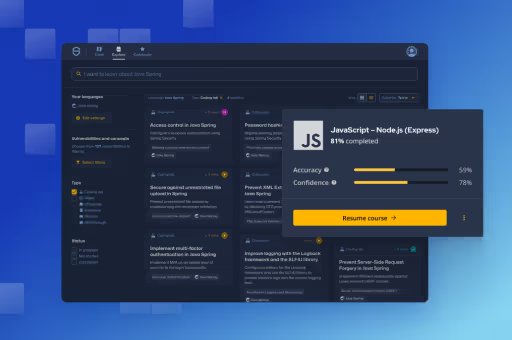
Secure Code Warrior는 소프트웨어 개발 라이프사이클 전반에 걸쳐 코드를 보호하고 사이버보안을 최우선으로 하는 문화를 구축하는 데 도움을 드립니다. 애플리케이션 보안 관리자, 개발자, CISO 또는 보안 담당자이든, 안전하지 않은 코드와 관련된 위험을 줄이는 데 도움을 드립니다.
데모 예약


마티아스 마두 박사는 보안 전문가, 연구원, CTO, 그리고 Secure Code Warrior의 공동 창립자입니다. 마티아스는 겐트 대학교에서 정적 분석 솔루션을 중심으로 애플리케이션 보안 분야 박사 학위를 취득했습니다.이후 미국의 Fortify에 합류하여 개발자가 안전한 코드를 작성하도록 지원하지 않고 단순히 코드 문제를 탐지하는 것만으로는 불충분하다는 점을 깨달았습니다. 이를 계기로 개발자를 지원하고 보안 부담을 줄이며 고객 기대를 뛰어넘는 제품을 개발하게 되었습니다. Team Awesome의 일원으로 책상에 있지 않을 때는 RSA 컨퍼런스, BlackHat, DefCon 등의 컨퍼런스에서 발표하는 무대 발표를 즐깁니다.
마티아스는 15년 이상의 소프트웨어 보안 실무 경험을 가진 연구자이자 개발자입니다. 포티파이 소프트웨어(Fortify Software)와 자신의 회사인 센세이 시큐리티(Sensei Security) 등 기업을 대상으로 솔루션을 개발해 왔습니다. 마티아스는 경력 전반에 걸쳐 여러 애플리케이션 보안 연구 프로젝트를 주도했으며, 이는 상용 제품으로 이어져 10건 이상의 특허를 취득했습니다.업무 외 시간에는 마티아스는 고급 애플리케이션 보안 교육 과정의 강사로 활동하며, RSA 컨퍼런스, 블랙햇, 디프콘, BSIMM, OWASP 앱섹, 브루콘 등 글로벌 컨퍼런스에서 정기적으로 발표를 진행하고 있습니다.
마티아스는 겐트 대학교에서 컴퓨터 공학 박사 학위를 취득했으며, 그곳에서 애플리케이션의 내부 동작을 숨기기 위한 프로그램 난독화를 통한 애플리케이션 보안을 연구했습니다.
While these seismic shifts in software development and security seem to be regular occurrences in 2026, the arrival of Anthropic's latest, reportedly "most dangerous" AI coding model yet, Claude Mythos, represents a permanent, fundamental shift in how every security leader must approach their security program, especially with patch management of legacy systems.
Most enterprises are still navigating the shift from human-written code to AI-assisted development, ushering in new processes, learning to review what their AI co-pilots generate, building new skills, and establishing new guardrails around appropriate enterprise use.
But, the next phase of AI-driven software creation didn't wait.
This week, Anthropic published a detailed technical assessment of Claude Mythos Preview, a new frontier AI model with a capability that should stop every security and engineering leader in their tracks. It can autonomously identify and exploit zero-day vulnerabilities across all major operating systems and browsers, without human intervention after an initial prompt. Engineers with no formal security training directed the model overnight and woke up to complete, working exploits.
These findings are startling and not theoretical. Mythos Preview found a 27-year-old vulnerability in OpenBSD, one of the most security-hardened operating systems in the world, that allowed an attacker to remotely crash any machine just by connecting to it. It discovered a 16-year-old flaw in FFmpeg that automated testing tools had hit five million times without catching. It chained together multiple Linux kernel vulnerabilities autonomously to achieve full machine control. These weren't human-assisted discoveries; no real-world practitioner guided the process after the initial prompt.
In response, Anthropic announced Project Glasswing, a cross-industry coalition that brings together AWS, Microsoft, Google, Cisco, CrowdStrike, Palo Alto Networks, JPMorgan Chase, NVIDIA, Apple, Broadcom, and the Linux Foundation. The shared conclusion across all of them: the old approaches to securing software are no longer sufficient, and the time to act is now. As CrowdStrike's CTO put it, the window between a vulnerability being discovered and exploited has collapsed; what once took months now happens in minutes.
The three problems just got harder
At every stage of the AI development transition, enterprises face the same three challenges. Mythos Preview sharpens all three at once, at a speed never previously possible.
Learning to build securely gets harder when AI can generate and modify code faster than teams can review it. The skills required to govern AI-generated code differ from those needed to write code manually, and those skills must keep pace with the tooling.
Governing what AI can and can't touch becomes critical when autonomous agents write and revise code without a human in the loop. Generally, we are still asking the wrong question. It’s less "what did our developers build?" and more "what did our AI build, and was it allowed to?"
Tracing which AI did what, where, and for whom is now a compliance and incident response imperative. When something goes wrong in an agentic pipeline, organizations need to answer that question immediately. Most can't.
As practitioners, we predicted long ago that this technology could eventually be leveraged by threat actors, effectively supercharging their attack capabilities. We already know that cybercriminals have a distinct offensive advantage over most enterprise security teams, and a tool like Mythos streamlines their nefarious processes even further.
We're in the age of democratized cyberattacks, where the level of destruction once achievable only by elite threat actors can be carried out by a relative novice. We shouldn't be shocked, but many remain vastly underprepared. Swift, prioritized patching is a must, but this management is only ever as good as the traceability of every tool and dependency in use.
This is an industry-level problem
What makes Project Glasswing significant isn't solely determined by the capabilities Mythos Preview revealed; it is the scale and potency of the response. A coalition spanning hyperscalers, security vendors, financial institutions, and open-source foundations is all aligned on the same conclusion, and it’s a familiar narrative that speaks directly to the ethos of SCW. AI Software Governance has never been a “nice-to-have”, optional feature. This is the missing layer that every organization scaling AI-driven development needs in place before the next incident. Those who stick to an oft-used, reactive playbook are going to be swept off their feet in the worst possible way.
Enablement, not restriction
The temptation when reading findings like these is to reach for the brakes, to slow AI adoption, restrict tooling, and tighten controls. That's the wrong response, and it's not what the Glasswing partners are recommending either.
The organizations that will navigate this transition well are the ones that adopt AI-driven development with governance in place from the start. That means training developers as the tooling evolves, setting guardrails for what AI agents can access in your repositories, and, fundamentally, building the traceability that your compliance and incident response teams will demand without burning millions of tokens to facilitate it.
The moment to act is now
Anthropic's own advice to defenders: start with the tools available today. Don't wait for the next model. The value of getting your processes, scaffolds, and governance frameworks in place compounds quickly.
Secure Code Warrior sits at the center of all three enterprise problems the agentic era creates. If your organization is scaling AI-driven development, the question isn't whether you need AI Software Governance. It's whether you have it yet.
What this means for you
최고정보보안책임자(CISO)를 위한
Your vulnerability disclosure policies, patch cycles, and incident response playbooks were built for a world where exploit development took weeks. That world is gone. Now is the time to establish AI governance visibility across your development environment, while contextually understanding which AI agents are touching your codebase, what they're producing, and whether it meets your risk threshold. If you can't answer those questions today, that's the gap to close first.
For CTOs
Your engineering teams are already using AI to ship faster. The question is now whether you have the guardrails in place to do it safely at scale. Governing what AI agents can and can't touch in your repositories, and maintaining traceability of AI contributions, is now a technical architecture decision, rather than an isolated security consideration. The organizations building this foundation now will be the ones who scale AI development with confidence.
For Engineering Leaders
Your developers are being asked to move faster with AI tools they didn't design and can't fully predict. The skills required to review AI-generated code are genuinely different from those required to write code manually, and most teams haven't had the chance to develop them yet. Closing that capability gap is what makes AI adoption safer and more sustainable.
For CEOs and Boards
Project Glasswing might be headline news, but it’s also a signal we cannot ignore. When AWS, Microsoft, Google, Cisco, CrowdStrike, and JPMorganChase align on an urgent, coordinated response to an AI-driven security risk, and Anthropic commits $100M to address it, that's the market telling you something. AI-driven software development is accelerating the rate at which vulnerabilities can be found and exploited. Governance over that process is now a board-level risk question. The organizations that treat it as one early will be better positioned to scale AI development — and to demonstrate to regulators, customers, and investors that they're doing it responsibly.


While these seismic shifts in software development and security seem to be regular occurrences in 2026, the arrival of Anthropic's latest, reportedly "most dangerous" AI coding model yet, Claude Mythos, represents a permanent, fundamental shift in how every security leader must approach their security program, especially with patch management of legacy systems.
Most enterprises are still navigating the shift from human-written code to AI-assisted development, ushering in new processes, learning to review what their AI co-pilots generate, building new skills, and establishing new guardrails around appropriate enterprise use.
But, the next phase of AI-driven software creation didn't wait.
This week, Anthropic published a detailed technical assessment of Claude Mythos Preview, a new frontier AI model with a capability that should stop every security and engineering leader in their tracks. It can autonomously identify and exploit zero-day vulnerabilities across all major operating systems and browsers, without human intervention after an initial prompt. Engineers with no formal security training directed the model overnight and woke up to complete, working exploits.
These findings are startling and not theoretical. Mythos Preview found a 27-year-old vulnerability in OpenBSD, one of the most security-hardened operating systems in the world, that allowed an attacker to remotely crash any machine just by connecting to it. It discovered a 16-year-old flaw in FFmpeg that automated testing tools had hit five million times without catching. It chained together multiple Linux kernel vulnerabilities autonomously to achieve full machine control. These weren't human-assisted discoveries; no real-world practitioner guided the process after the initial prompt.
In response, Anthropic announced Project Glasswing, a cross-industry coalition that brings together AWS, Microsoft, Google, Cisco, CrowdStrike, Palo Alto Networks, JPMorgan Chase, NVIDIA, Apple, Broadcom, and the Linux Foundation. The shared conclusion across all of them: the old approaches to securing software are no longer sufficient, and the time to act is now. As CrowdStrike's CTO put it, the window between a vulnerability being discovered and exploited has collapsed; what once took months now happens in minutes.
The three problems just got harder
At every stage of the AI development transition, enterprises face the same three challenges. Mythos Preview sharpens all three at once, at a speed never previously possible.
Learning to build securely gets harder when AI can generate and modify code faster than teams can review it. The skills required to govern AI-generated code differ from those needed to write code manually, and those skills must keep pace with the tooling.
Governing what AI can and can't touch becomes critical when autonomous agents write and revise code without a human in the loop. Generally, we are still asking the wrong question. It’s less "what did our developers build?" and more "what did our AI build, and was it allowed to?"
Tracing which AI did what, where, and for whom is now a compliance and incident response imperative. When something goes wrong in an agentic pipeline, organizations need to answer that question immediately. Most can't.
As practitioners, we predicted long ago that this technology could eventually be leveraged by threat actors, effectively supercharging their attack capabilities. We already know that cybercriminals have a distinct offensive advantage over most enterprise security teams, and a tool like Mythos streamlines their nefarious processes even further.
We're in the age of democratized cyberattacks, where the level of destruction once achievable only by elite threat actors can be carried out by a relative novice. We shouldn't be shocked, but many remain vastly underprepared. Swift, prioritized patching is a must, but this management is only ever as good as the traceability of every tool and dependency in use.
This is an industry-level problem
What makes Project Glasswing significant isn't solely determined by the capabilities Mythos Preview revealed; it is the scale and potency of the response. A coalition spanning hyperscalers, security vendors, financial institutions, and open-source foundations is all aligned on the same conclusion, and it’s a familiar narrative that speaks directly to the ethos of SCW. AI Software Governance has never been a “nice-to-have”, optional feature. This is the missing layer that every organization scaling AI-driven development needs in place before the next incident. Those who stick to an oft-used, reactive playbook are going to be swept off their feet in the worst possible way.
Enablement, not restriction
The temptation when reading findings like these is to reach for the brakes, to slow AI adoption, restrict tooling, and tighten controls. That's the wrong response, and it's not what the Glasswing partners are recommending either.
The organizations that will navigate this transition well are the ones that adopt AI-driven development with governance in place from the start. That means training developers as the tooling evolves, setting guardrails for what AI agents can access in your repositories, and, fundamentally, building the traceability that your compliance and incident response teams will demand without burning millions of tokens to facilitate it.
The moment to act is now
Anthropic's own advice to defenders: start with the tools available today. Don't wait for the next model. The value of getting your processes, scaffolds, and governance frameworks in place compounds quickly.
Secure Code Warrior sits at the center of all three enterprise problems the agentic era creates. If your organization is scaling AI-driven development, the question isn't whether you need AI Software Governance. It's whether you have it yet.
What this means for you
최고정보보안책임자(CISO)를 위한
Your vulnerability disclosure policies, patch cycles, and incident response playbooks were built for a world where exploit development took weeks. That world is gone. Now is the time to establish AI governance visibility across your development environment, while contextually understanding which AI agents are touching your codebase, what they're producing, and whether it meets your risk threshold. If you can't answer those questions today, that's the gap to close first.
For CTOs
Your engineering teams are already using AI to ship faster. The question is now whether you have the guardrails in place to do it safely at scale. Governing what AI agents can and can't touch in your repositories, and maintaining traceability of AI contributions, is now a technical architecture decision, rather than an isolated security consideration. The organizations building this foundation now will be the ones who scale AI development with confidence.
For Engineering Leaders
Your developers are being asked to move faster with AI tools they didn't design and can't fully predict. The skills required to review AI-generated code are genuinely different from those required to write code manually, and most teams haven't had the chance to develop them yet. Closing that capability gap is what makes AI adoption safer and more sustainable.
For CEOs and Boards
Project Glasswing might be headline news, but it’s also a signal we cannot ignore. When AWS, Microsoft, Google, Cisco, CrowdStrike, and JPMorganChase align on an urgent, coordinated response to an AI-driven security risk, and Anthropic commits $100M to address it, that's the market telling you something. AI-driven software development is accelerating the rate at which vulnerabilities can be found and exploited. Governance over that process is now a board-level risk question. The organizations that treat it as one early will be better positioned to scale AI development — and to demonstrate to regulators, customers, and investors that they're doing it responsibly.
아래 링크를 클릭하여 이 자료의 PDF를 다운로드하십시오.
Secure Code Warrior는 소프트웨어 개발 라이프사이클 전반에 걸쳐 코드를 보호하고 사이버보안을 최우선으로 하는 문화를 구축하는 데 도움을 드립니다. 애플리케이션 보안 관리자, 개발자, CISO 또는 보안 담당자이든, 안전하지 않은 코드와 관련된 위험을 줄이는 데 도움을 드립니다.
보고서 표시데모 예약
마티아스 마두 박사는 보안 전문가, 연구원, CTO, 그리고 Secure Code Warrior의 공동 창립자입니다. 마티아스는 겐트 대학교에서 정적 분석 솔루션을 중심으로 애플리케이션 보안 분야 박사 학위를 취득했습니다.이후 미국의 Fortify에 합류하여 개발자가 안전한 코드를 작성하도록 지원하지 않고 단순히 코드 문제를 탐지하는 것만으로는 불충분하다는 점을 깨달았습니다. 이를 계기로 개발자를 지원하고 보안 부담을 줄이며 고객 기대를 뛰어넘는 제품을 개발하게 되었습니다. Team Awesome의 일원으로 책상에 있지 않을 때는 RSA 컨퍼런스, BlackHat, DefCon 등의 컨퍼런스에서 발표하는 무대 발표를 즐깁니다.
마티아스는 15년 이상의 소프트웨어 보안 실무 경험을 가진 연구자이자 개발자입니다. 포티파이 소프트웨어(Fortify Software)와 자신의 회사인 센세이 시큐리티(Sensei Security) 등 기업을 대상으로 솔루션을 개발해 왔습니다. 마티아스는 경력 전반에 걸쳐 여러 애플리케이션 보안 연구 프로젝트를 주도했으며, 이는 상용 제품으로 이어져 10건 이상의 특허를 취득했습니다.업무 외 시간에는 마티아스는 고급 애플리케이션 보안 교육 과정의 강사로 활동하며, RSA 컨퍼런스, 블랙햇, 디프콘, BSIMM, OWASP 앱섹, 브루콘 등 글로벌 컨퍼런스에서 정기적으로 발표를 진행하고 있습니다.
마티아스는 겐트 대학교에서 컴퓨터 공학 박사 학위를 취득했으며, 그곳에서 애플리케이션의 내부 동작을 숨기기 위한 프로그램 난독화를 통한 애플리케이션 보안을 연구했습니다.
While these seismic shifts in software development and security seem to be regular occurrences in 2026, the arrival of Anthropic's latest, reportedly "most dangerous" AI coding model yet, Claude Mythos, represents a permanent, fundamental shift in how every security leader must approach their security program, especially with patch management of legacy systems.
Most enterprises are still navigating the shift from human-written code to AI-assisted development, ushering in new processes, learning to review what their AI co-pilots generate, building new skills, and establishing new guardrails around appropriate enterprise use.
But, the next phase of AI-driven software creation didn't wait.
This week, Anthropic published a detailed technical assessment of Claude Mythos Preview, a new frontier AI model with a capability that should stop every security and engineering leader in their tracks. It can autonomously identify and exploit zero-day vulnerabilities across all major operating systems and browsers, without human intervention after an initial prompt. Engineers with no formal security training directed the model overnight and woke up to complete, working exploits.
These findings are startling and not theoretical. Mythos Preview found a 27-year-old vulnerability in OpenBSD, one of the most security-hardened operating systems in the world, that allowed an attacker to remotely crash any machine just by connecting to it. It discovered a 16-year-old flaw in FFmpeg that automated testing tools had hit five million times without catching. It chained together multiple Linux kernel vulnerabilities autonomously to achieve full machine control. These weren't human-assisted discoveries; no real-world practitioner guided the process after the initial prompt.
In response, Anthropic announced Project Glasswing, a cross-industry coalition that brings together AWS, Microsoft, Google, Cisco, CrowdStrike, Palo Alto Networks, JPMorgan Chase, NVIDIA, Apple, Broadcom, and the Linux Foundation. The shared conclusion across all of them: the old approaches to securing software are no longer sufficient, and the time to act is now. As CrowdStrike's CTO put it, the window between a vulnerability being discovered and exploited has collapsed; what once took months now happens in minutes.
The three problems just got harder
At every stage of the AI development transition, enterprises face the same three challenges. Mythos Preview sharpens all three at once, at a speed never previously possible.
Learning to build securely gets harder when AI can generate and modify code faster than teams can review it. The skills required to govern AI-generated code differ from those needed to write code manually, and those skills must keep pace with the tooling.
Governing what AI can and can't touch becomes critical when autonomous agents write and revise code without a human in the loop. Generally, we are still asking the wrong question. It’s less "what did our developers build?" and more "what did our AI build, and was it allowed to?"
Tracing which AI did what, where, and for whom is now a compliance and incident response imperative. When something goes wrong in an agentic pipeline, organizations need to answer that question immediately. Most can't.
As practitioners, we predicted long ago that this technology could eventually be leveraged by threat actors, effectively supercharging their attack capabilities. We already know that cybercriminals have a distinct offensive advantage over most enterprise security teams, and a tool like Mythos streamlines their nefarious processes even further.
We're in the age of democratized cyberattacks, where the level of destruction once achievable only by elite threat actors can be carried out by a relative novice. We shouldn't be shocked, but many remain vastly underprepared. Swift, prioritized patching is a must, but this management is only ever as good as the traceability of every tool and dependency in use.
This is an industry-level problem
What makes Project Glasswing significant isn't solely determined by the capabilities Mythos Preview revealed; it is the scale and potency of the response. A coalition spanning hyperscalers, security vendors, financial institutions, and open-source foundations is all aligned on the same conclusion, and it’s a familiar narrative that speaks directly to the ethos of SCW. AI Software Governance has never been a “nice-to-have”, optional feature. This is the missing layer that every organization scaling AI-driven development needs in place before the next incident. Those who stick to an oft-used, reactive playbook are going to be swept off their feet in the worst possible way.
Enablement, not restriction
The temptation when reading findings like these is to reach for the brakes, to slow AI adoption, restrict tooling, and tighten controls. That's the wrong response, and it's not what the Glasswing partners are recommending either.
The organizations that will navigate this transition well are the ones that adopt AI-driven development with governance in place from the start. That means training developers as the tooling evolves, setting guardrails for what AI agents can access in your repositories, and, fundamentally, building the traceability that your compliance and incident response teams will demand without burning millions of tokens to facilitate it.
The moment to act is now
Anthropic's own advice to defenders: start with the tools available today. Don't wait for the next model. The value of getting your processes, scaffolds, and governance frameworks in place compounds quickly.
Secure Code Warrior sits at the center of all three enterprise problems the agentic era creates. If your organization is scaling AI-driven development, the question isn't whether you need AI Software Governance. It's whether you have it yet.
What this means for you
최고정보보안책임자(CISO)를 위한
Your vulnerability disclosure policies, patch cycles, and incident response playbooks were built for a world where exploit development took weeks. That world is gone. Now is the time to establish AI governance visibility across your development environment, while contextually understanding which AI agents are touching your codebase, what they're producing, and whether it meets your risk threshold. If you can't answer those questions today, that's the gap to close first.
For CTOs
Your engineering teams are already using AI to ship faster. The question is now whether you have the guardrails in place to do it safely at scale. Governing what AI agents can and can't touch in your repositories, and maintaining traceability of AI contributions, is now a technical architecture decision, rather than an isolated security consideration. The organizations building this foundation now will be the ones who scale AI development with confidence.
For Engineering Leaders
Your developers are being asked to move faster with AI tools they didn't design and can't fully predict. The skills required to review AI-generated code are genuinely different from those required to write code manually, and most teams haven't had the chance to develop them yet. Closing that capability gap is what makes AI adoption safer and more sustainable.
For CEOs and Boards
Project Glasswing might be headline news, but it’s also a signal we cannot ignore. When AWS, Microsoft, Google, Cisco, CrowdStrike, and JPMorganChase align on an urgent, coordinated response to an AI-driven security risk, and Anthropic commits $100M to address it, that's the market telling you something. AI-driven software development is accelerating the rate at which vulnerabilities can be found and exploited. Governance over that process is now a board-level risk question. The organizations that treat it as one early will be better positioned to scale AI development — and to demonstrate to regulators, customers, and investors that they're doing it responsibly.
목차
마티아스 마두 박사는 보안 전문가, 연구원, CTO, 그리고 Secure Code Warrior의 공동 창립자입니다. 마티아스는 겐트 대학교에서 정적 분석 솔루션을 중심으로 애플리케이션 보안 분야 박사 학위를 취득했습니다.이후 미국의 Fortify에 합류하여 개발자가 안전한 코드를 작성하도록 지원하지 않고 단순히 코드 문제를 탐지하는 것만으로는 불충분하다는 점을 깨달았습니다. 이를 계기로 개발자를 지원하고 보안 부담을 줄이며 고객 기대를 뛰어넘는 제품을 개발하게 되었습니다. Team Awesome의 일원으로 책상에 있지 않을 때는 RSA 컨퍼런스, BlackHat, DefCon 등의 컨퍼런스에서 발표하는 무대 발표를 즐깁니다.
Secure Code Warrior는 소프트웨어 개발 라이프사이클 전반에 걸쳐 코드를 보호하고 사이버보안을 최우선으로 하는 문화를 구축하는 데 도움을 드립니다. 애플리케이션 보안 관리자, 개발자, CISO 또는 보안 담당자이든, 안전하지 않은 코드와 관련된 위험을 줄이는 데 도움을 드립니다.
데모 예약[다운로드]시작하기 위한 리소스


Trust Agent:AI - Secure and scale AI-Drive development
AI is writing code. Who’s governing it? With up to 50% of AI-generated code containing security weaknesses, managing AI risk is critical. Discover how SCW's Trust Agent: AI provides the real-time visibility, proactive governance, and targeted upskilling needed to scale AI-driven development securely.
OpenText 애플리케이션 보안의 힘 + Secure Code Warrior
OpenText Application Security and Secure Code Warrior combine vulnerability detection with AI Software Governance and developer capability. Together, they help organizations reduce risk, strengthen secure coding practices, and confidently adopt AI-driven development.

Secure Code Warrior corporate overview
Secure Code Warrior is an AI Software Governance platform designed to enable organizations to safely adopt AI-driven development by bridging the gap between development velocity and enterprise security. The platform addresses the "Visibility Gap," where security teams often lack insights into shadow AI coding tools and the origins of production code.
시작하기 위한 리소스
Post-Quantum Cryptography: Quantum Computers Will Break Today’s Encryption – Are You Ready?
Post-quantum cryptography (PQC) is critical for protecting data from quantum computing threats. Learn how “harvest now, decrypt later” exposes risk and how developers can prepare for quantum-safe security.